A seasonal product makes timing part of the offer
Mailchimp’s historical case describes The Peach Truck touring with peaches during summer and using email to stay in touch with customers around a short seasonal selling window. The account says campaign timing followed the season, with tour schedule messages during summer and less frequent notes in the off-season. [1] The marketing challenge is not simply to send more often; it is to make each message useful at the moment a customer can act.
Mailchimp also reports that the business segmented campaigns by geography and signup source, including online popups and in-person tour stops. [1] That account is historical and does not verify current routes or present-day campaign operations. The analysis here considers why place and timing form part of the marketing strategy, then outlines a proposed sequence as an independent recommendation.
Match geographic relevance to the decision
When an offer depends on a tour stop or a limited season, a message that omits where and when can impose extra work on the reader. Geography can help answer whether a schedule announcement is relevant; signup source can help clarify what kind of follow-up may be useful. Mailchimp’s case gives the example of tailoring content for people who bought in person and people who ordered online. [1] That is reported case detail, not a claim that the following sequence was used.
As an interpretation, segmentation is most useful when it changes the next action presented. A local schedule notice should help a recipient decide whether to check a nearby stop; a post-purchase note should support use of the product already bought. A location check should be part of the proposed send process: confirm that the relevant stop or area is still applicable before scheduling. This safeguard is suggested here, not documented execution.
Workshop: three sends, three different audience rules
The original calendar makes relevance a condition of sending. Relative days refer to a fictional local stop, not a current tour date. Each proposed message has one action, an eligibility rule and a suppression rule that can prevent an inappropriate reminder.
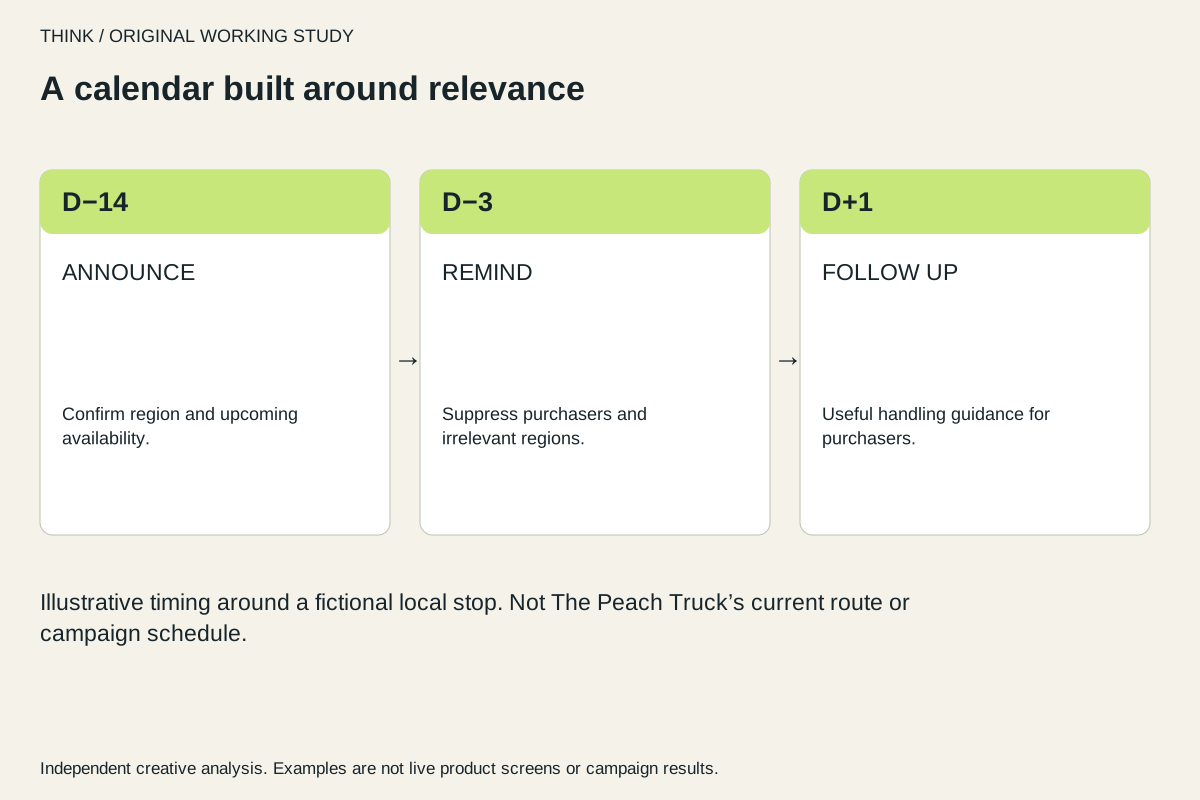
| Relative day | Audience | Subject draft | Single action | Suppress when |
|---|---|---|---|---|
| D−14 | Confirmed relevant region | Seasonal availability for your area | Review the local schedule | No confirmed local relevance or no applicable consent |
| D−3 | Relevant region; no completed action | A reminder for your local stop | Review local details | Purchased, opted out, cancelled stop or changed region |
| D+1 | Confirmed purchasers | A useful next step after your purchase | Read handling guidance | No purchase or no applicable marketing permission |
The announcement and reminder can use the same offer without serving the same audience. A completed purchase changes what the reader needs next, so a purchaser moves to helpful follow-up rather than receiving another urgency message. A changed or cancelled local stop should also suppress the planned reminder; a stale regional segment is not a reason to send.
Before scheduling, make the eligibility rule reproducible and assign an owner to verify the local detail. After sending, compare qualified downstream actions within a consistent window and inspect unsubscribes alongside response. The CSV is a working send plan with invented copy, not an export of the original business’s segmentation or a promise of a particular result.
Take the working files
Proposed sequence: announce, remind, follow up
First, an announce email could tell a recipient that seasonal availability or a local tour window is approaching, then offer one action: view the schedule for their area. Second, a reminder could be sent only to recipients whose geographic relevance has been checked and who have not completed the intended purchase or schedule action; its single action could be to review the available local details. Third, a follow-up could thank purchasers and provide a useful next step, such as storage or preparation guidance, with one action to view that guidance. These are proposed examples, not messages reported in the case.
Suppressing a reminder after a sale is a suggested practice to reduce irrelevant prompts. The sequence should also suppress recipients who have opted out and respect the email program’s applicable consent and delivery rules. Neither suppression behavior nor these exact emails are asserted as part of The Peach Truck’s historical execution.
Measure action and unwanted friction
A proposed measurement plan would track delivered-message conversion and unsubscribes for each send. Define conversion before launch as a specified action attributable to that email, such as a completed purchase or schedule interaction, then report the denominator and attribution window. Compare segments only when the audience definition and tracking method are consistent. These are proposed KPIs; Mailchimp’s case does not provide conversion results for this sequence.
For campaign attribution, Google Analytics documents adding source, medium, and campaign parameters to referral links so campaign traffic can be identified in reporting, and recommends consistent naming. [2] A proposed implementation would use a stable naming convention across the three messages and keep creative variants distinct where needed. Tracking can identify attributed visits, but it cannot by itself prove that an email caused a purchase.
Protect the authentic seasonal voice
Our proposed review would compare messages within the same selling period and geographic eligibility rules. A full-list seasonal update and a reminder to one tour-stop segment have different jobs and audiences. Keep their results separate, then examine whether the sequence helped recipients find a relevant stop and complete a purchase.
As a practical next step, draft the three messages with one action each, verify geographic eligibility and purchase suppression rules, and test links and campaign naming before sending. Afterward, review delivered-message conversion alongside unsubscribes and the exact audience definitions. Use results to refine timing and relevance; do not treat the reported historical open rates as a target or as evidence that this proposed plan will succeed.
Sources & useful references
- Mailchimp: The Peach Truck seasonal email marketing
- Google Analytics: collecting campaign data with custom URLs
Results are attributed to the original publisher. Proposed tests and creative recommendations are our analysis.