The challenge: help players tell what kind of answer they will get
This is an original concept study for BestBuild, a videogame builds website. No traffic, ranking, user research, conversion experiment or completed rebrand is documented. The challenge addressed here is therefore a positioning question: how might a site help a player judge whether a build recommendation fits their character, game version and constraints?
In our interpretation, a broad promise to provide builds can leave important questions unanswered. Players may need to know which role a build serves, which game version it applies to, and what assumptions it makes about available equipment or play style. The proposed positioning should make those decision boundaries visible instead of implying that one recommendation suits everyone.
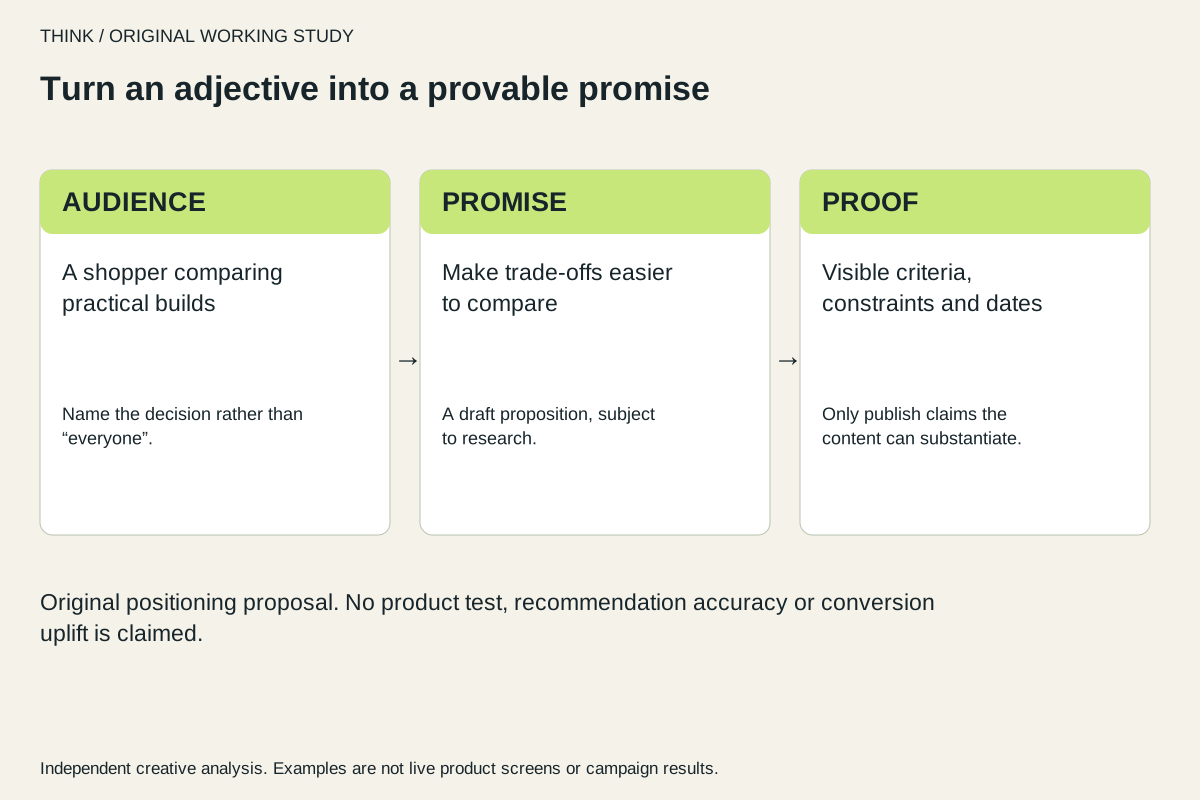
A proposed promise organized around player context
We propose a positioning statement along these lines: “BestBuild helps players compare builds by role, game version and the constraints that shape how they play.” This is a draft concept, not existing site copy. Its value would depend on whether the site can support those distinctions with accurate, current information.
Google’s people-first content guidance encourages useful, original information, clear sourcing and content that helps readers accomplish their goal. [1] Applied here, that suggests a promise should be matched by page structure and evidence: label the game version, explain the intended role, and show the basis for recommendations. The site should not assert a build’s effectiveness without supporting gameplay sources.
Workshop: a promise-and-proof message system
This original positioning map and copy matrix turn broad claims into reviewable choices. The generic drafts are invented prompts, not quotations from the current site. Every proposed alternative names the evidence needed before it could become a defensible public promise.
| Generic draft | Task-led option | Evidence required | Review question |
|---|---|---|---|
| “The best build” | “Compare the trade-offs before you choose” | Explicit criteria, limits and a maintained comparison | Can a reader explain the trade-off? |
| “Expert guidance” | “See why each choice fits this brief” | Named evaluation method and accountable review | Can a reader locate the reason for a choice? |
| “Always up to date” | “Check the review date and what changed” | Actual review timestamp and change record | Can an editor keep this promise true? |
A stronger sentence is useful only if the product or content can support it. “See why each choice fits this brief” requires a visible method; “check the review date” requires an actual review process. The evidence column therefore acts as a release condition, not decoration beneath a brand slogan. Avoid moving an unproven superlative into the page title merely because it sounds more distinctive.
Use the matrix in a small comprehension test. Ask participants which decision the page helps with, what its limits are and where they would verify a recommendation. Record the words they use before choosing final copy. Those observations can inform another draft, but they do not establish a conversion improvement or independently validate any underlying product recommendation.
Take the working files
Draft messages to test, not claims of completed work
Proposed landing headline: “Find a build that fits your role, version and play style.” Proposed email subject: “A build guide with the version and role up front.” Proposed search ad: “Compare videogame builds by role and version. Check the assumptions before you choose.” These are illustrative creative options, not published campaign assets or claims about particular character builds.
Our interpretation is that the three messages should preserve the same decision promise while adapting to each channel’s space. A voice guide could favor direct, specific language; name uncertainty where evidence is incomplete; and avoid unsupported superlatives such as “best” unless the page explains its criteria. A claims checklist should ask whether each recommendation identifies a version, role, evidence source and relevant limitations.
Make the promise observable across channels
A practical test would show players a landing page or message and ask them to explain what the site offers, which player context it covers, and what they would need to verify before using a recommendation. Record comprehension and confidence separately; confidence without accurate understanding can expose overstatement rather than success. Also ask participants to identify any missing context that would change their choice.
For campaign attribution, consistent source, medium and campaign parameters can help distinguish referring campaigns in Google Analytics reports. [2] In our proposed measurement plan, use stable naming across ads and email variants, then compare qualified visits and meaningful guide engagement by channel. Those measures are proposed; there are no observed BestBuild results to report.
Next steps: establish accuracy before expanding the message
First, inventory the information a guide can reliably substantiate and define the version-labeling convention. Then draft a small set of page and campaign messages using the same positioning, and run the comprehension exercise before broader distribution. If players misunderstand the intended role or version, revise the wording and supporting page details before treating the concept as ready.
The site destination offers useful context for examining this brief because it identifies the owner-related videogame builds subject, helping readers assess whether the proposed role-and-version promise fits the site’s intended topic. This study remains a proposal; it does not report completed design, traffic changes or business outcomes.
Sources & useful references
- Google: creating helpful, reliable, people-first content
- Google Analytics: collecting campaign data with custom URLs
Results are attributed to the original publisher. Proposed tests and creative recommendations are our analysis.