Make the product’s constraint the creative system
Oura announced “Wear Your Best Life” on 8 October 2026 as a fall campaign for Oura Ring 5. The company describes a miniature city built at one-tenth scale, populated by hands wearing the ring and filmed practically. It says the campaign was developed with agency Nice+Frank and director Sam Walker, and intended to extend across television, out-of-home, social media and retail. These are details in Oura’s own campaign account, not independent evidence of audience response. [1]
The useful design move is to treat a physical limitation as an organizing idea. A ring is small and is worn on a hand, so close framing is already part of showing it. The campaign account says the team used that close viewpoint as the basis for its visual language, rather than treating it only as a product-photography problem. In our reading, the hand becomes both the scale reference and the character: the object remains visible while gestures give the miniature scenes human activity.
Give the miniature a job beyond novelty
Oura reports that the production included 12 custom-built sets, eight miniature cars and 35 modelmakers; construction took three weeks in Prague. It describes working subway lights, moving cars, pumped water and underwater camera setups in miniature pools. Those details explain how the world was made, but a list of craft feats is not yet a communication strategy. The miniature matters because it makes the hand’s movements legible as ordinary routines in a city. A practical set can supply real surfaces, light and physical interaction; it does not automatically make a product benefit clear. [1]
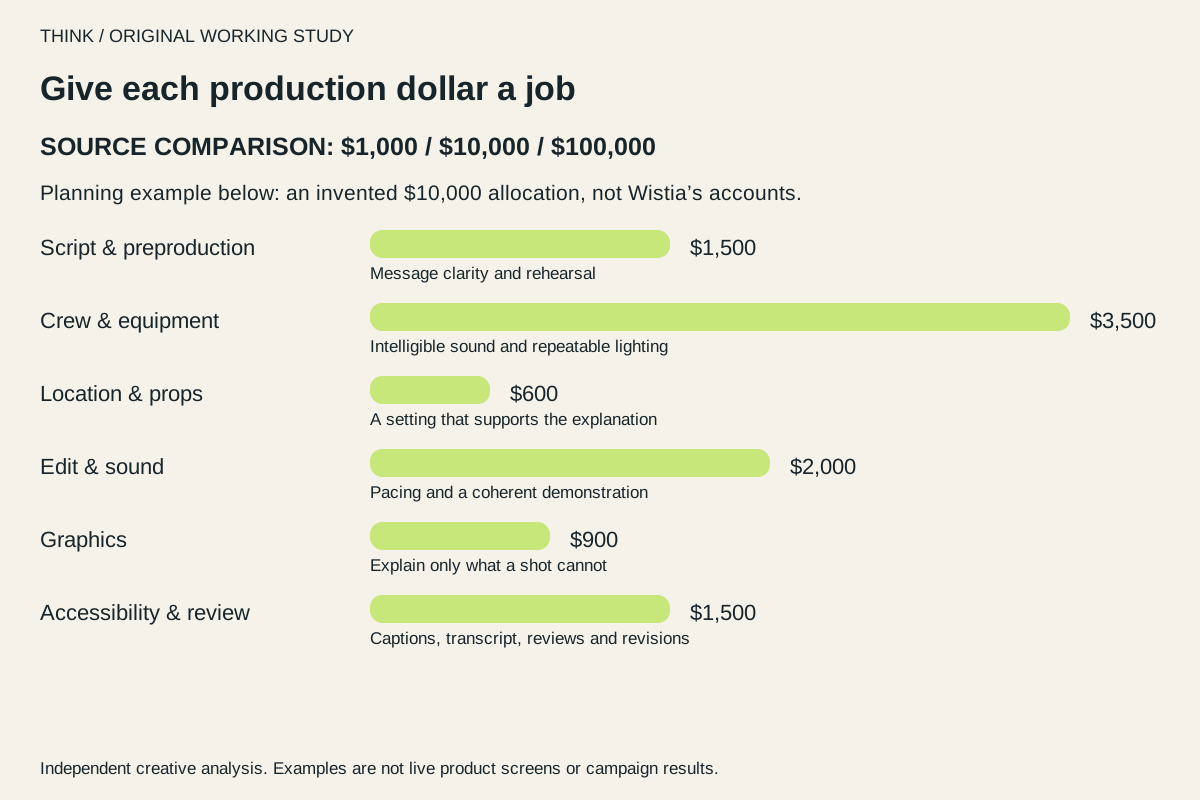
This distinction is useful when planning a smaller production. Put each proposed build beside the message it must carry. A moving model bus might establish a daily commute; a tiny pool might suggest leisure. If a prop only adds intricacy, ask whether the same money and screen time would better serve a readable product demonstration, a clearer setting, or an accessible version of the scene. It is whether the chosen technique helps the audience follow the intended action.
Design the story for reuse across formats
Oura says the campaign was planned for several channels and describes a handoff from filming through a seven-day edit and coordinated preparation of assets for global touchpoints. The company’s source does not publish a channel-by-channel asset list, spend, reach or conversion results, so none should be inferred from the rollout description. [1]
For a hypothetical product campaign, build a simple versioning matrix before the shoot. Columns might be the audience question, required shot, framing, duration, caption or text treatment, and destination action. Rows could cover a full film, a short social cut, a silent out-of-home execution and a retail display. If the product disappears when the frame is cropped vertically, that is a production problem to solve on set, not just in post. A shared visual premise can make variations feel related while leaving each placement enough room to do its own job.
Make accessibility part of the production brief
A visual miniature can carry meaning that spoken narration does not repeat: which hand moves, what it touches, or how the ring fits into a scene. W3C’s planning guidance says teams should assess whether a video’s audio and visual information need captions, description or a descriptive transcript, and plan those requirements during production. For a campaign built around visual action, this is a concrete preproduction question: what information would be lost if a viewer could not see the image? The exact answer depends on the finished edit and its audio. [2]
A practical review can happen at storyboard stage. Write a plain-language description of each essential action, then compare it with the spoken track and captions. If the image alone introduces a necessary fact, add that information to narration or a descriptive transcript, or plan an audio-described version where appropriate. W3C distinguishes requirements by content and conformance level; the production team should evaluate the finished media against the applicable standard rather than assume one format fits every deliverable.
Measure the message separately from the making
Oura’s campaign post gives production facts and rollout plans, but no measured change in awareness, understanding, purchase behavior or health. A case study should preserve that boundary. For another brand, a useful evaluation might ask a defined audience what product they noticed, what the scene showed it doing, and what claim they believe the film makes. Report the sample, timing, wording and comparison condition before interpreting the answers. Views can describe distribution; they cannot by themselves show that a person understood the demonstration or found it credible.
The broader lesson is modest and transferable: begin with a product truth that can be shown, find a visual form that makes it distinctive, then check whether the form clarifies the truth across placements. Oura’s small wearable and hand-centered campaign offer one documented example of turning a constraint into a production language. The production scale is not a template for every budget. A tabletop prop, a tight camera move or a repeatable screen demonstration may serve another team better, provided the creative choice makes the intended product action easier to see and the evidence for its effect is reported honestly.
Sources & useful references
- Oura: Building the Handmade World of Oura’s Latest Brand Campaign
- W3C: planning accessible audio and video
Results are attributed to the original publisher. Proposed tests and creative recommendations are our analysis.