Three budgets, one product
Sandwich documents making three ads for Wistia’s browser-based video app Soapbox at production budgets of $1,000, $10,000, and $100,000. The project also recorded the making process as a feature-length documentary intended to serve as an educational resource for video makers. [1]
These are production budgets. Sandwich describes a shared explainer approach, without publishing a commercial return-on-investment winner for the three ads. [1]
Our interpretation is that the useful question is not simply what a larger budget buys in visible polish. The comparison invites teams to ask which creative decisions need time, skill, equipment, or coordination—and whether those decisions help a viewer understand the product. Budget is an input. The purpose of the work and the response of its intended audience require separate examination.
Separate clarity from finish
Our proposed comparison starts with script clarity. Before assessing production, write the main message of each version in one sentence. Does the viewer learn what Soapbox is and what task it supports? A polished frame cannot repair a confusing proposition. In a future project, teams could compare scripts before filming to identify unclear claims early, when revisions cost less.
Next, examine time for performance: how many opportunities does the presenter have to deliver the message naturally, and how much room is there for pacing or a clearer example? Then look at art direction: does the setting help viewers understand the product, or merely decorate the scene? Finally, assess production polish, such as image consistency and sound. These are proposed review questions, not factual claims about the comparative quality of Sandwich’s finished ads.
Workshop: a budget you can challenge line by line
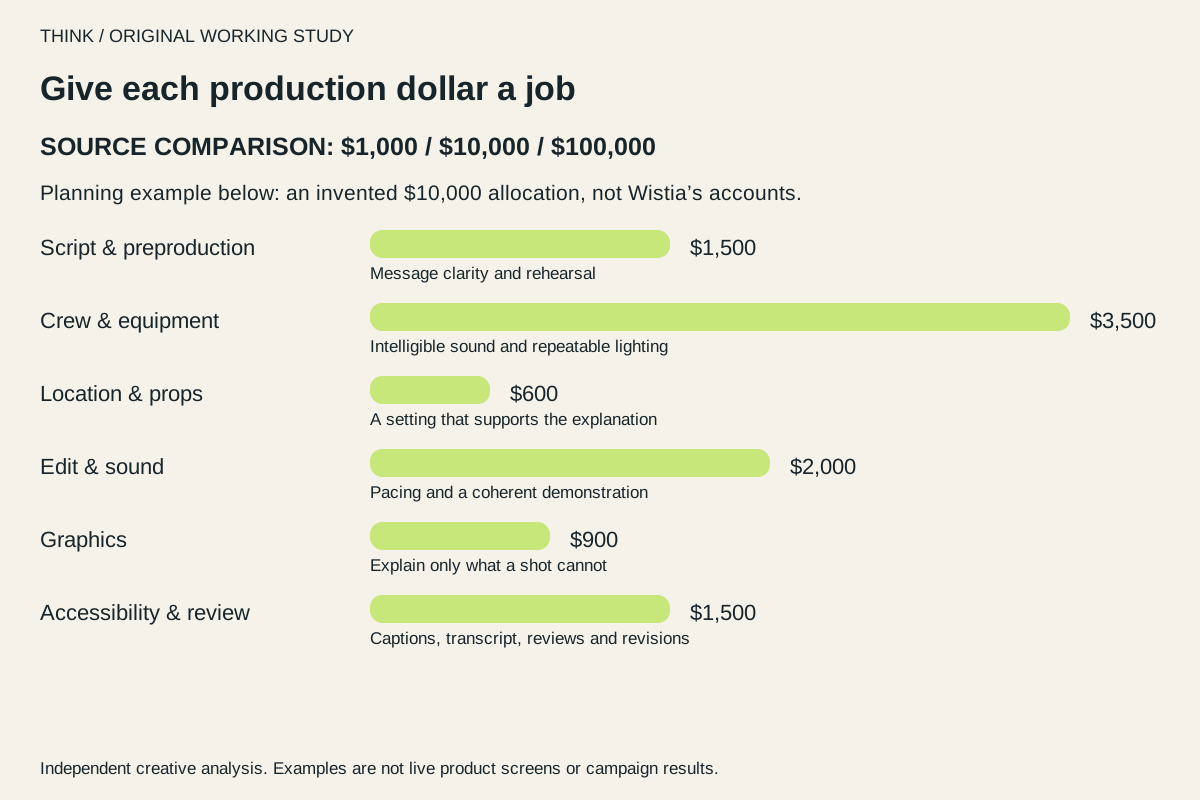
The three original production totals are a useful prompt, but they do not disclose a line-item budget or prove a return on spend. This original worksheet instead allocates a hypothetical $10,000 production and makes the audience purpose of every allowance visible.
| Allowance | Example USD | What it protects |
|---|---|---|
| Script & preproduction | 1500 | Message clarity and rehearsal |
| Crew & equipment | 3500 | Intelligible sound and repeatable lighting |
| Location & props | 600 | A setting that supports the explanation |
| Edit & sound | 2000 | Pacing and a coherent demonstration |
| Graphics | 900 | Explain only what a shot cannot |
| Accessibility & review | 1500 | Captions, transcript, reviews and revisions |
The six allowances sum to $10,000. They exclude distribution, tax, travel and external talent fees; those would need separate estimates. Change the numbers to fit a real scope, name the owner of each line, then enter planned and actual spend in the downloadable CSV. A source total should never be presented as evidence for these proposed allocations.
If the scope must shrink, remove an optional setting or graphic before removing intelligible sound or caption review. Run the same message-comprehension questions after each rough cut. Keep a record of misunderstandings and correction costs: this makes a production review more useful than asking which version merely looks expensive.
Take the working files
A worksheet for budget choices
A practical budget allocation worksheet could list each decision, the resource it needs, and the audience purpose it serves. For example: script development and revisions; presenter rehearsal or additional takes; location and props; camera, lighting, and sound; editing and graphics; captions, transcript, and visual description. Teams can assign a planned amount or time allowance to each line, then record what they actually used. This is a proposed planning tool, not a reconstruction of the original project’s spending.
For each line, ask what would be lost if it were reduced and what would improve if it were expanded. That turns the budget into explicit choices. W3C recommends planning media accessibility early. [2] Reserve a caption review and a transcript check alongside the final edit, with a named person responsible for each.
Compare comprehension without bias
Our proposed blinded message-comprehension test would show each ad to participants without identifying its budget. Ask them to explain the product in their own words, identify one task it helps with, and say what they would need to know next. The test can also measure whether viewers recognize the main message after a short delay. Use the same questions, presentation conditions, and audience criteria for each version so the comparison is interpretable.
Keep the budget labels hidden until participants have recorded their answers. Then compare the misunderstanding each version creates: an unclear feature, an unfamiliar term or a missing use case. Those observations would guide the next edit; a live campaign would still need its own distribution and commercial measurement.
Let business value remain an open question
Our recommendation is to use the three-budget comparison as a discussion prompt before approving a production estimate. List the parts that must work in every version—an intelligible offer, a representative demonstration and a useful next step—then decide which improvements require additional resources.
A team applying this framework should first define the audience and job, then test comprehension, and only after that connect the winning message to a distribution plan and a business measure such as qualified product trials. Any such measure would be a proposed KPI requiring its own tracking design. Expensive finish alone cannot establish commercial value; distribution and measurement are necessary to assess whether the work contributed to a business outcome.
Sources & useful references
Results are attributed to the original publisher. Proposed tests and creative recommendations are our analysis.