The challenge: turn an item question into a complete answer
This is an original concept study for How2GetIt, an owner-related videogame item-acquisition website. Its established subject is where to find or farm items in games. No newsletter feature, subscriber list, experiment or lead lift is asserted here. [3]
A search visitor often arrives with a narrow task: identify a source, understand prerequisites, and decide what to do next. Our interpretation is that a useful page should resolve the immediate question before asking for an email address. An optional follow-up can then support a continuing task, rather than withholding the answer to generate a signup.
A proposed guide with source and prerequisite checks
An illustrative item-guide page could state the item name and relevant game version, then organize the answer into source, prerequisites and follow-up steps. It might include a clearly labeled verification note describing when the information was checked and which gameplay sources support it. These are proposed components; no specific game, item location or current guide content is claimed.
Google’s people-first guidance emphasizes original, useful information, transparent sourcing and helping a reader complete their goal. [1] For this concept, that means distinguishing verified information from uncertainty and giving enough context for a reader to judge whether the answer applies. No item facts should be drafted until they can be checked against appropriate gameplay sources.
Workshop: a journey with explicit counting rules
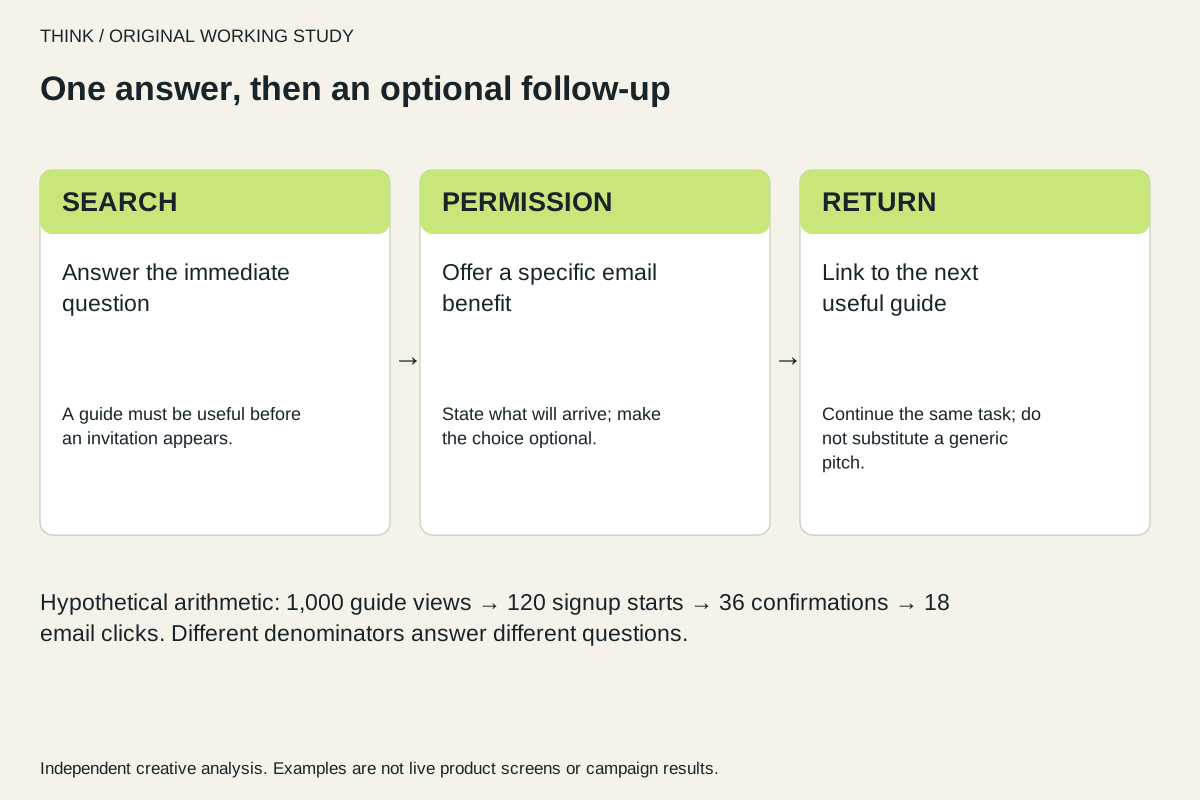
This original journey starts with the answer the reader came for and treats email as an optional continuation. The worksheet defines proposed events and denominators before any implementation. Its 1,000 → 120 → 36 → 18 example is invented to expose how different conversion statements can describe the same funnel.
| Proposed event | Definition | Permitted context | Counting rule |
|---|---|---|---|
| guide_view | A guide document becomes available | Guide slug only | One defined view unit; separate server and browser counts |
| signup_started | A visitor chooses the optional invitation | Content group, placement | Not a confirmed subscription |
| signup_confirmed | A consented signup is confirmed | Content group | Deduplicate confirmations; no email address in analytics |
| email_guide_click | A campaign link opens the intended guide | Campaign label, guide slug | Link clicks and people are different units |
The most useful change in this design is not the placement of an email form; it is the relationship between the guide’s question, the permission promise and the follow-up destination. A generic newsletter invitation would break that continuity. Review those three pieces of copy together, and keep the immediate answer available to readers who decline the invitation.
In the worked example, 36 confirmations divided by 1,000 guide views is 3.6%, while 36 divided by 120 starts is 30%. Neither figure proves that the guide caused a signup. The downloadable sequence states when recipient counts and click counts are comparable and avoids personal data in proposed event properties. Treat these as planning definitions, not collected events.
An optional signup with a concrete reason to return
A proposed signup proposition could offer occasional follow-up when a reader wants more guidance about locating or obtaining items, with a clear description of what messages contain and how often they are sent. This is a concept, not an existing newsletter feature. The page should make the answer available without signup and let readers choose whether continued help is useful.
In our interpretation, qualified opt-ins matter more than raw signups: the useful signal is a person who understands the offer, consents to receive it and finds the follow-up relevant. Suggested checks include confirmation completion, unsubscribe patterns and repeat visits to related guides. These are proposed indicators, not measured How2GetIt performance.
Three proposed emails that continue the same task
Proposed email one would recap the guide’s source and prerequisites, with a reminder to confirm the game version. Email two could offer a checklist for evaluating whether a source or farming route applies to the reader’s circumstances, without inventing a real route. Email three could invite the reader back to a related, verified guide or ask which item question should be covered next. These are illustrative messages, not an implemented sequence.
Each email should provide standalone value and a clear reason for its next step. We suggest measuring delivered messages, useful guide visits and voluntary repeat engagement alongside opt-outs, then interpreting those measures together. For campaign identification, consistent source, medium and campaign parameters can distinguish traffic from email and search in analytics reports. [2]
Next steps: test a matched path from search to follow-up
A proposed test would compare matched groups receiving the same guide and signup offer, with one group eligible for the three-email follow-up and a comparison group seeing the guide without that sequence. Define the eligible audience, consent flow, attribution window and primary outcome in advance. Compare qualified opt-ins and useful repeat visits per eligible visitor, while also checking whether readers completed the original task. Do not treat an increase in signups alone as proof of value.
Before implementing the sequence, verify the item facts, linked resources and email operations. Assess whether the follow-up helps readers complete a useful next task, alongside its effect on engagement and opt-outs. The study reports no measured campaign result.
Sources & useful references
- Google: creating helpful, reliable, people-first content
- Google Analytics: collecting campaign data with custom URLs
- How2GetIt
Results are attributed to the original publisher. Proposed tests and creative recommendations are our analysis.