Start with the resistance
Sandwich’s account begins with a familiar sales obstacle: its founder initially declined Slack’s invitation because the team felt it already had adequate tools. After trying the product, the team found that it changed how they worked and recognized that their own reversal could help explain it to similarly skeptical prospects. [1]
That resistance gives the story a reason to begin. Instead of opening with a product claim, the film can start with a belief the intended viewer may share: our current setup is enough. The tension is specific and answerable. What would make this team reconsider? The audience does not need to accept a broad promise before seeing why the product might matter.
Make the work problem visible
Sandwich filmed in its office in a documentary style, with team members playing themselves. The film also reenacted the email exchange that started the project, including the founder’s refusal. Rather than relying on technical detail and interface shots, the production grounded Slack’s features in people interacting. [1]
Those choices connect the product to a recognizable workplace situation. The office supplies context; the real team’s initial reluctance supplies credibility; interaction makes the product’s role part of the story. Slack’s current help describes channels as dedicated spaces that bring relevant people together, a useful explanation of the product concept today but not evidence of the launch film’s historical feature set. [2]
Workshop: an objection-first 30-second board
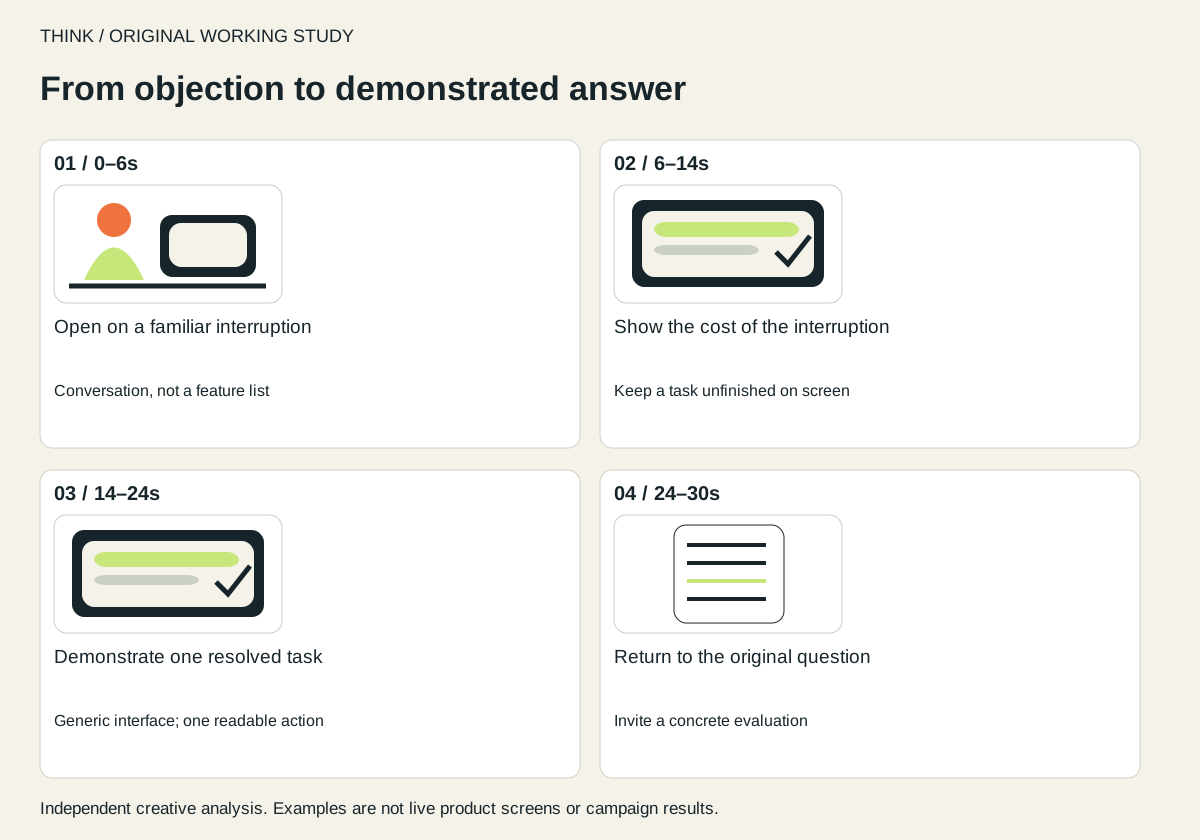
This proposed sequence adapts the article’s storytelling lesson to a generic workplace product. It does not reproduce the original Slack film. Four frames keep the customer’s objection connected to one visible answer, with a deliberate return to the opening problem.
| Time | Story beat | Direction |
|---|---|---|
| 0–6s | Open on a familiar interruption | Conversation, not a feature list |
| 6–14s | Show the cost of the interruption | Keep a task unfinished on screen |
| 14–24s | Demonstrate one resolved task | Generic interface; one readable action |
| 24–30s | Return to the original question | Invite a concrete evaluation |
Write the voiceover only after the task and proof shot are chosen. In the first six seconds, the audience should recognize a problem without needing to learn a product category. The central ten seconds need to demonstrate a credible change, not cut between decorative interface details. If the demonstration cannot be followed at mobile size, simplify the task or allow more time.
The CSV includes a blank voiceover draft column so a team can use its own audience language. Review the board with the opening and closing frames side by side: does the final invitation resolve the same objection? Record comprehension errors before using click-through as a later distribution measure.
Take the working files
Let the reversal carry the explanation
The change of mind is the hinge: skepticism becomes firsthand experience, then a story the production team believes it can retell. Sandwich says the human, humorous treatment also helped define the brand; that is the maker’s interpretation of its creative work, not independent evidence of campaign effectiveness. [1]
For a different B2B service, a proposed three-shot variation could preserve the narrative logic without copying the film: first, show a team repeating a workaround they consider normal; second, show the interruption or handoff that exposes its cost; third, show one person using the service to complete that handoff while a colleague responds. Each shot should make a distinct point, and the final beat should show the service in context rather than ask a narrator to declare victory.
Test comprehension before polish
A practical next step would be to show a rough cut to people who match the intended buyer, then ask them to describe the work problem, what changed, and what the service did. Record whether their explanations match the intended use case; do not treat enthusiasm as proof of understanding. If viewers identify the problem but cannot explain the service’s role, revise the interaction or add a clarifying beat. If they understand the mechanics but miss why the team resisted, strengthen the opening situation.
A second pass could compare two edits: one that opens on the objection and one that opens on the visible workaround. Keep the audience and viewing conditions consistent, and assess unaided explanations against the same questions. This would test which opening makes the use case easier to grasp, without claiming that either edit will improve conversion.
Keep the evidence in view
The account records the maker’s approach and firsthand product experience. Our suggested next review would ask whether viewers recognize the workplace problem and can explain the change the product enables. A clear answer would support the creative direction; a conversion claim would require a separate campaign experiment.
The transferable lesson is narrower and more useful: when a product is hard to explain, a credible objection can frame the work, and a visible change in how people coordinate can make the use case concrete. For a new campaign, document the intended audience, the objection being dramatized, and the specific action that demonstrates the service’s role. Then test comprehension directly and report the findings separately from the creative rationale.
Sources & useful references
Results are attributed to the original publisher. Proposed tests and creative recommendations are our analysis.